
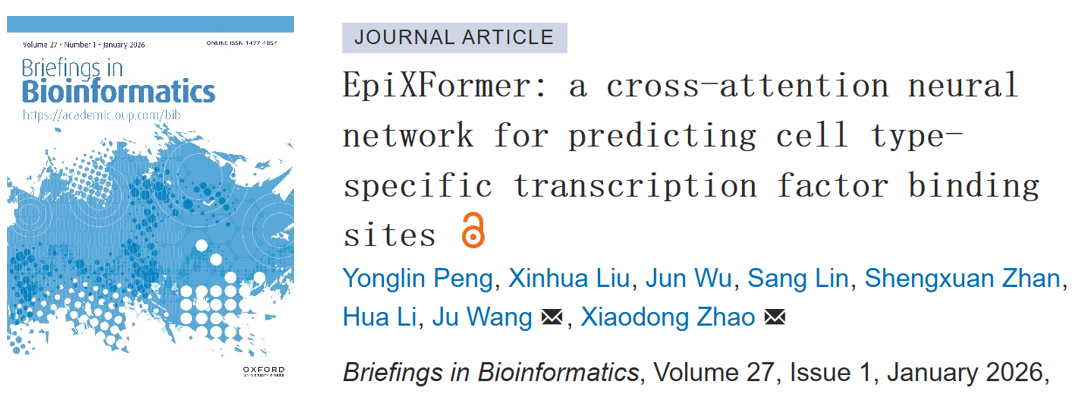
Professor Xiaodong Zhao's team from Shanghai Center for Systems Biomedicine at Shanghai Jiao Tong University, together with collaborators, recently published a research paper entitled "EpiXFormer: a cross-attention neural network for predicting cell type-specific transcription factor binding sites" in Briefings in Bioinformatics. In this study, they developed a new model named EpiXFormer based on a Transformer deep neural network in the study, which is designed to predict cell type-specific transcription factor binding sites.
Transcription factors are a class of proteins that recognize and bind to specific DNA sequences in the genome, influencing chromatin structure and gene transcription, thereby regulating cell differentiation and individual development. Constrained by the local chromatin environment, the binding of transcription factors to the genome is often cell type-specific. Mutations in transcription factors or their binding sites are closely associated with various diseases. Systematically deciphering cell type-specific transcription factor binding sites is of great importance for understanding mechanisms related to development and disease. However, given the vast number of transcription factors and hundreds of cell types in humans, identifying cell type-specific transcription factor binding sites through experimental techniques such as ChIP-seq poses significant challenges in terms of feasibility and cost. Developing highly accurate and interpretable computational methods has become an urgent need for decoding cell-specific transcription factor regulatory networks.
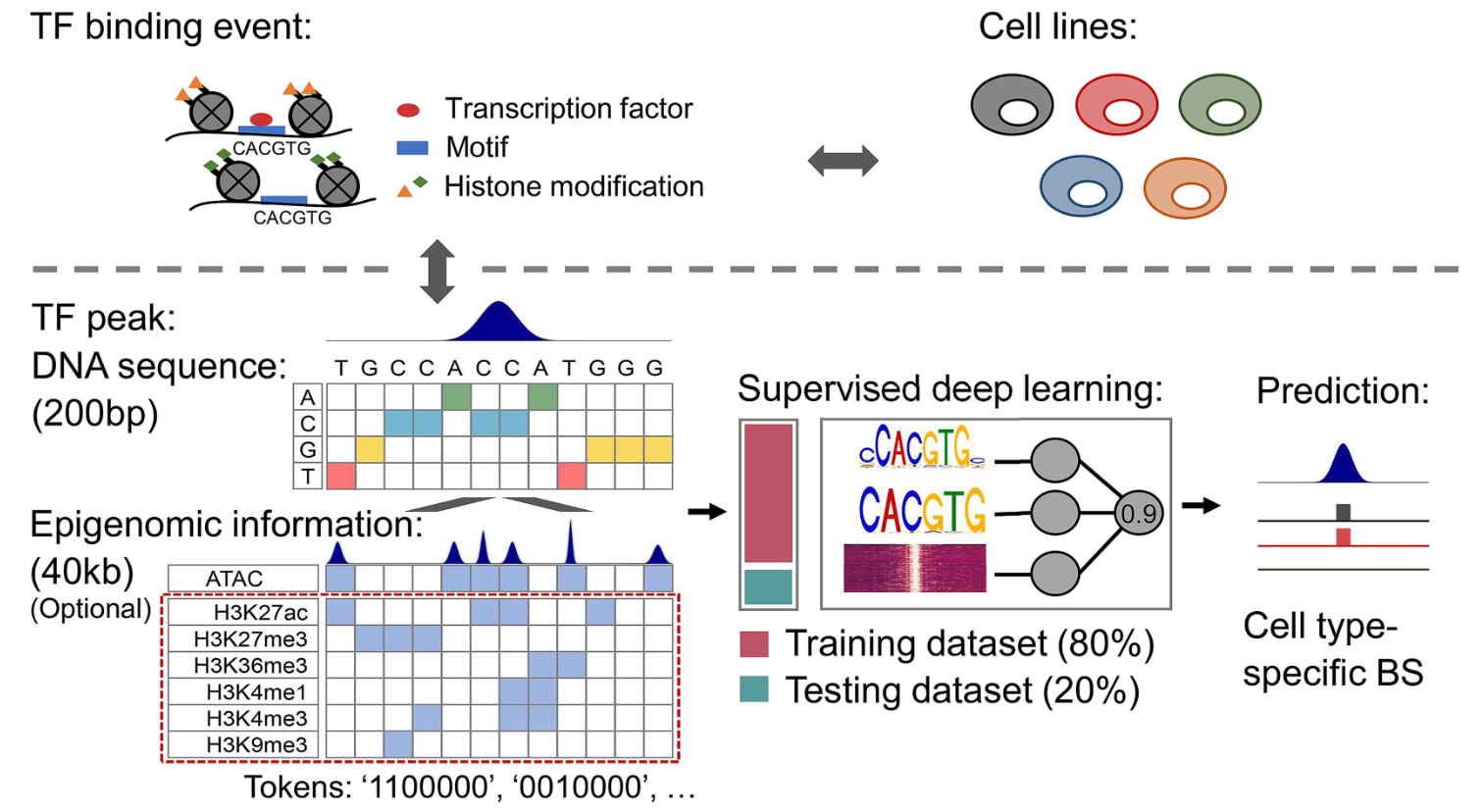
EpiXFormer uses DNA sequences as its core input features while integrating six key types of histone modification information, such as H3K27ac and H3K4me3, along with chromatin accessibility epigenetic data. By employing an encoder-decoder architecture, the model establishes correlations between DNA sequence features and epigenetic information characteristics. The model has demonstrated strong predictive performance in tests using data from the Encyclopedia of DNA Elements (ENCODE)
project, covering 7 cell lines and 43 DNA-binding proteins. Furthermore, this model can be utilized to infer active pioneer factors during cell type transitions, helping to identify potential pioneer factors that play driving roles at different stages of developmental processes or the progression of diseases, including cancer. By incorporating a cross-attention mechanism, EpiXFormer significantly enhances model interpretability without compromising its high prediction accuracy, thus achieving an effective balance between the two.
Prof. Xiaodong Zhao from Shanghai Center for Systems Biomedicine and Prof. Ju Wang from School of Biomedical Engineering at Tianjin Medical University serve as co-corresponding authors of this article. Yonglin Peng (PhD student) from Prof. Xiaodong Zhao’s team is the first author. This work was supported by the National Natural Science Foundation of China (NSFC) and the National Key Research and Development Program of China.
Paper Link:https://academic.oup.com/bib/article/27/1/bbaf721/8424000

Address:800 Dongchuan Road, Shangha
Fax:200240
Tel:021-34206059